






Aim of sessions:
The aim of the Go Sailing sessions at Waldringfield Sailing Club (WSC) is to give students basic sailing skills and knowledge required to enjoy recreational sailing safely all through relaxed tuition. The Go Sailing session offers students the opportunity of learning in predominantly double-handed dinghies.
Typical Go Sailing lesson plan for inexperienced and experienced sailors:
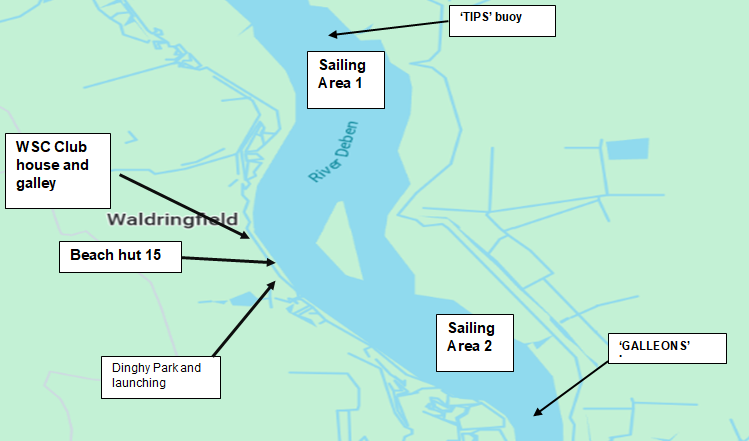
0915hrs-0930hrs: Beach Hut 15 (halfway between the clubhouse and the dinghy park)
- Assemble and sign in.
- Facilities and safety briefing
- Completion of risk assessment
- Slip ways, booms, ropes etc.
- Check clothing and provide buoyancy aids as appropriate.
- GS coordinator to confirm sailing areas with safety boat cover.
- GS coordinator to ensure radio communications is established and maintained.
- Reminder of the “Rules of the Road”
- Pair up (for double-handed boats)
- Allocate boats.
- Facilities and safety briefing
0930 – 0945hrs: Dinghy Park
- Wind awareness direction and strength.
- Course outline
- Rig, reef (if necessary) and launch.
0945-1130hrs On Water
- Activity in line with session plan A, B or C.
1130-1145hrs Dinghy Park
- Coming ashore and recovery of boat.
- Derigging of boats
- Cleaning down, covers and securing of boats.
- Debriefing of Instructors and crews
- Reporting of defects, accidents and near misses
Go Sailing Coordinator
The Go Sailing coordinator will have an overview of both the singlehanded and doublehanded Go Sailing sessions monitoring any safety issues through the safety team and the experienced helms. The GS coordinator will brief and debrief instructors as required.
Session delivery
Onshore and on water sessions will be delivered by experienced helms.
Go sailing session overview
- Typical content of session for novices and inexperienced sailors (level 1)
| Activity | Location |
| Rigging and reefing (2 handers) the sails | On shore |
| Basic sailing knots | On shore |
| Name that boat part | On shore |
| Land/boat drills- Tacking and gybing | On shore/on water |
| Launching and Leaving the shore | On shore |
| Points of sail, no go zone and wind awareness | On shore and on water |
| 5 Sailing essentials | On shore and on water |
| Sailing a sausage course | On water |
| Returning to the shore | On water |
| Coming ashore and recovery of boat | On water and on shore |
- Typical content of session for sailors with some experience (Level 2)
| Activity | Location |
| Rigging and reefing (2 handers) the sails | On shore |
| Launching and leaving the shore | On shore and on water |
| Impact of tide, moorings and other boats | On shore and on water |
| 5 Sailing essentials | On shore and on water |
| Sailing a triangle or square course | On water |
| Follow the leader | On water |
| Capsize and recovery (theory/practice) | On shore and on water |
| Coming alongside (mooring/safety boat) | On water |
| Man overboard recovery (2 hander only) | On water |
| Follow the leader | On water |
| Coming ashore and recovery of boat | On water and on shore |
C) Typical content of session for more experienced sailors looking to further develop their skills (Level 2)
| Activity | Location |
| Rigging and reefing the sails | On shore |
| Launching and leaving the shore | On shore and on water |
| Sailing a triangle or square course | On water |
| Coming alongside (mooring/safety boat) | On water |
| Man overboard recovery (2 hander only) | On water |
| Boat handling (5 sailing essentials) | On water |
| Sailing in close company/rules of the road | On water |
| Follow my leader | On water |
| Hold position on a mark, heave too | On water |
| 360/720’s around a buoy | On water |
| Coming ashore and recovery of boat | On water and on shore |
GS coordinator to allocate session according to ability.
Single-handed and double handed boats:
Will use either slipway from the dinghy park and sailing areas 1 or 2 depending on the tide and wind direction as allocated by the Senior Instructor in consultation with the safety boat cover.
Sailing areas:
The sessions will either take place upriver in the “Tips” buoy area (Area 1) or down river in the “Galleons” buoy area (Area 2), subject to tide, wind and available water and safety boat cover.
Description of club Boats used during the sessions.
Double-handed:
Hartley 15: The H15 is 15.4 feet (4.7 meters) in length ismade from roto moulded polyethylene, resulting in a durable and robust hull. The boat is designed to be very stable, making it ideal for beginners and those learning to sail and so making it an ideal training boat. As a training boat it is stable and large enough to accommodate an instructor and two students. The high boom provides excellent visibility and headroom, reducing the risk of bumping heads.
Laser Bahia: The Bahia is 15.1 feet in length (4.6 meters) is also made from roto-moulded polyethylene. The Laser Bahia is a versatile, family-friendly sailing dinghy known for its stability, ease of handling, and ability to be sailed, making it suitable for both leisure and racing, and popular with sailing schools as a training boat. As a training boat it is stable and large enough to accommodate an instructor and two students. The high boom provides excellent visibility and headroom, reducing the risk of bumping heads.
Wayfarer (Mk 4): The Wayfarer Mk4 is 15 feet 10 inches in length (4.83 m) and a versatile GRP dinghy built by Hartley Boats. The Wayfarer is a popular choice for training, cruising, and racing, known for its stability and seaworthiness. The boat is broad and deep enough for three adults to comfortably sail for several hours. As a training boat it is stable and large enough to accommodate an instructor and two students. The Wayfarer is a class which is raced at Waldringfield Sailing club.
Single handed:
ILCA/Laser: The ILCA/Laser dinghy is a popular, one-design, single-handed sailing dinghy, known for its simplicity, ease of rigging, and competitive sailing, with three rig options (4.7, Radial, and Standard) to suit different sailor weights and wind conditions.
